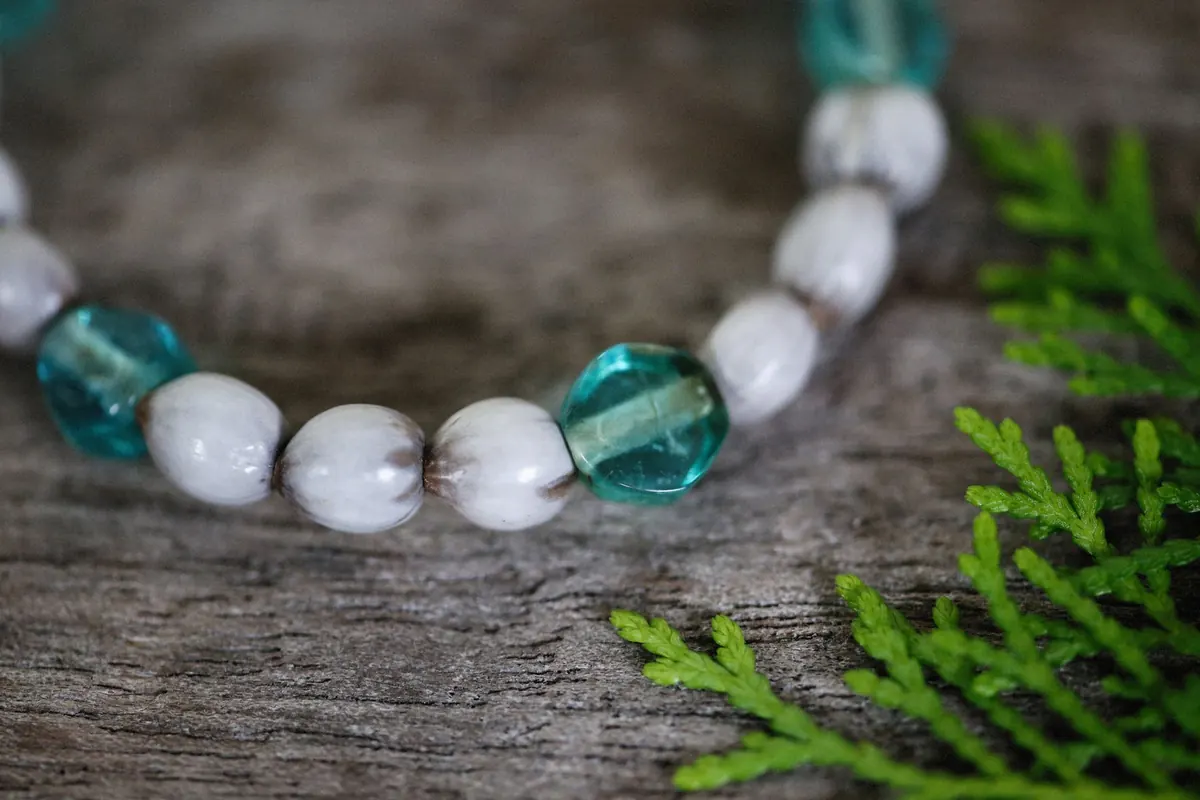
Turquoise is one of the few gemstones most of us still meet in person: a tray at a weekend market, a booth at a mineral show, a cuff in a vintage shop. That is part of its charm, and part of the difficulty. Convincing imitation turquoise is everywhere, and the light at a market stall is not kind to anyone trying to make a careful decision with a phone in one hand and a coffee in the other.
The reassuring part is that imitations almost always give themselves away somewhere. Not always at first glance, and not always in the same place, but somewhere. What follows are the six signals worth checking, in roughly the order you can check them while standing at a table.
1. The colour is too even to be true
Natural turquoise wanders. A single cabochon might move from pale sky at one edge to a deeper blue-green in the middle, with a faint patchiness where the stone was closer to the host rock. Some pieces are strikingly uniform, but even those usually show some shift in tone when you tilt them into better light.
Imitation tends toward flatness. Dyed howlite and dyed magnesite often sit at one confident blue with no variation at all, sometimes with a faint grey or green undertone that reads as slightly "off" without being easy to name. Look at the drill holes of beads and the edges of cabochons, where colour should continue naturally into the stone rather than stopping like paint. A darker line where the stone meets the setting is another small tell: dye collects in cracks and crevices, so the darkest colour is often at the bottom of a fissure rather than spread evenly through it.
One more clue, though it takes time to notice: natural turquoise often darkens or shifts slightly greener over years of contact with skin, oils and sunlight. Plastic does not age. If a fifty-year-old piece looks exactly as bright as the day it was strung, that is worth a question.
2. The matrix looks drawn rather than grown
Matrix is the host rock running through the stone — the brown and yellow limonite veins, the black chert, the occasional metallic fleck of pyrite. Natural matrix has depth and irregularity. Veins narrow and widen, split, and sometimes fade out. If you look closely with a loupe, you can usually see the boundary where stone ends and matrix begins.
Fake matrix is usually the giveaway. It tends to be uniformly black, evenly wide, and oddly crisp at the edges, as if it were inked on. Spiderweb patterns repeat. Veins stop abruptly at the edge of the stone instead of wrapping around the sides, or appear on the face but never on the back. On dyed howlite, the natural grey veining often looks blurred, with dye bleeding into the surrounding white in a way real turquoise does not.
Common stand-ins you will meet
- Dyed howlite — white or grey veined stone soaked in blue dye. The most frequent fake by a wide margin.
- Dyed magnesite — similar, often sold with a convincing spiderweb pattern.
- Block or reconstituted turquoise — crushed stone dust mixed with resin and pressed into shape. Speckled, uniform, no true matrix.
- Plastic and resin — sometimes with real stone dust added, sometimes not. Light, warm, occasionally with visible mold seams.
- Glass and ceramic — including the old "Vienna turquoise," which is glass and always was.
- Other stones renamed — dyed jasper sold as "African turquoise," howlite sold as "white buffalo," chrysocolla or variscite offered loosely as turquoise.
3. Feel the weight and the temperature
Stone is cold when you first pick it up, and it holds that cold for a moment. Plastic and resin warm to your hand almost immediately. Stone is also heavier than it looks; a chunky plastic cabochon has a hollow lightness that becomes obvious once you have handled a few real pieces side by side.
Glass is heavy and cold like stone, so weight alone will not rule it out — but glass is smooth and glassy, with none of the waxy, slightly porous surface of turquoise. Under a loupe, plastic may show tiny bubbles or flow lines, and pressed block material often has a speckled, cookie-dough texture where the grains of crushed stone sit in resin. A gentle tap of two beads together makes a small click in stone, a dull thud in plastic and a ring in glass. None of these tests is conclusive on its own. Together they narrow the field quickly.
4. Test for dye, carefully
If you are at a shop with a cooperative seller, ask to test an inconspicuous spot — the back of a bezel, the edge of a cabochon, the inside of a bead hole. Rub gently with a cotton swab dampened with acetone or nail polish remover. Real, undyed turquoise leaves the swab clean. Dyed material often gives up colour within seconds.
Two cautions. Acetone can dull the finish on resin-stabilised stones and on some settings, so test the smallest possible area and never on a piece you do not intend to buy. And a seller who will not allow any inspection at all has told you something useful. If you cannot test, look instead: dye pools in cracks, sits darker around the base of prongs, and sometimes leaves a faint blue stain on the skin or the cloth of a display tray.
5. Turn the piece over
The back of a piece is where shortcuts hide. Look for a flat plate of plastic, epoxy or a cheaper stone glued behind a thin slice of turquoise — a doublet, which is legitimate when disclosed but should never be sold as a solid stone. Look for a seam line, a mold mark, or bubbles trapped in resin. Look for colour that continues straight into a backing material with no change in texture, which suggests the whole thing was cast or pressed rather than cut.
On Native American and Southwestern work in particular, a backed stone is common and not automatically dishonest. What matters is whether anyone told you. A backing changes the value, and a seller who explains it is a seller worth staying with.
6. Read the label and ask two questions
Words do a lot of work in this trade. "Turquoise colour," "turquoise matrix," "faux" and "imitation" are all fair descriptions of something that is not turquoise. "African turquoise" is usually dyed jasper; "white buffalo" is howlite. None of these is a scam on its own — the problem starts when the qualifier is spoken quietly and the word "turquoise" is said loudly.
Ask two things: "Is this natural, stabilised, or dyed?" and "Is it solid or backed?" Stabilised turquoise — stone impregnated with resin to harden it — is the norm for most of what is sold today, because much rough turquoise is too porous to cut otherwise. It is still turquoise. Dye is a different matter, and a dealer who handles good stock will answer both questions plainly, without a story attached.
A short checklist for the next market
- Look at the colour in daylight if you can, and check the edges and drill holes for pooling dye.
- Trace one matrix vein with your eye: does it wrap around the stone or stop dead at the edge?
- Hold it. Cold and heavy is a good start; warm and light is a quick exit.
- Turn it over. Backing, seams and bubbles all live on the back.
- Ask about treatment and backing, and listen for a straight answer.
- Check the return policy before you pay. A written receipt with the treatment named is worth more than any stall-side opinion.
None of this requires a geology degree, and none of it takes more than a minute or two per piece. Buy a little less, look a little closer, and the tray of bright blue cuffs becomes far easier to read.
Photo: Alexey Demidov / Pexels