Put three quartz points side by side on a table and a beginner will often guess they come from different minerals. One is as clear as a water glass, one looks like frozen milk, and one carries a brownish smoke that seems to sit inside the stone rather than on it. All three are silicon dioxide, all three share the same trigonal crystal system and the same hardness of 7 on the Mohs scale. What changed is the story each crystal recorded while it grew.
That is the idea worth holding on to. Quartz varieties are not separate species. They are the same mineral nudged into different appearances by chemistry, temperature, growth speed, and radiation. Once you know which lever did what, the labels stop feeling arbitrary and start acting like useful shorthand.
How Growth Conditions Write the Difference
Quartz grows when silica-rich fluids cool slowly enough for atoms to attach in an orderly pattern. Change the pace or the chemistry of that fluid and the result changes with it. Three factors do most of the work:
- Speed. Slow, steady growth leaves few defects, so light passes straight through. Fast growth traps tiny bubbles of the mineral-forming fluid inside the crystal, and the stone turns cloudy.
- Impurities. Aluminium, iron, titanium, and lithium appear in trace amounts and can take the place of silicon in the lattice, changing the way the crystal absorbs light.
- Radiation. Low-level natural radioactivity from surrounding rock can displace electrons in the lattice over long stretches of time, shifting colourless material toward smoky brown or violet.
None of this is exotic. Most quartz on Earth has been through at least one of these conditions, which is exactly why flawless clear crystal is scarcer than the cloudy material that fills pegmatites and hydrothermal veins.
The Everyday Trio: Clear, Milky, and Smoky
Clear quartz (rock crystal)
Clear quartz is the benchmark. It formed slowly, in a pocket with enough space and a stable supply of silica, and it cooled without a rush. Look closely at a good specimen and you will still usually find something: a faint growth line, a tiny veil of bubbles near the base, a chip of host rock caught at the point. Those marks are not flaws in the commercial sense; they are evidence that the crystal grew rather than came out of a mould.
In hand, clear quartz feels cool and dense, and it will scratch glass without much effort. That hardness is also why it survives in river gravels long after softer minerals have worn away.
Milky quartz
Milky quartz is the same material, grown too quickly. The cloudiness comes from countless microscopic fluid inclusions — water and carbon dioxide trapped as the crystal advanced. It is usually massive rather than sharply terminated, common in veins and as the white filling between other minerals.
Not all milkiness is equal. Hold a piece up to a lamp: a soft, even glow suggests fine, evenly distributed inclusions, while a blotchy, uneven look often means the crystal grew in bursts. Both are normal, and both are cheap enough that beginners can afford to compare several pieces side by side.
Smoky quartz
Smoky quartz gets its colour from natural irradiation acting on traces of aluminium in the lattice. The shade ranges from a pale champagne to a near-black brown that only shows its transparency when backlit. Well-formed smoky points from granite pegmatites are among the most satisfying specimens to own because the colour is intrinsic, not a coating.
Watch for pieces described as smoky where the darkening is patchy and concentrated at the very tip. That happens naturally too, but an abrupt, painted-looking edge is worth a second look.
Colour From Trace Elements: Amethyst, Citrine, and Rose Quartz
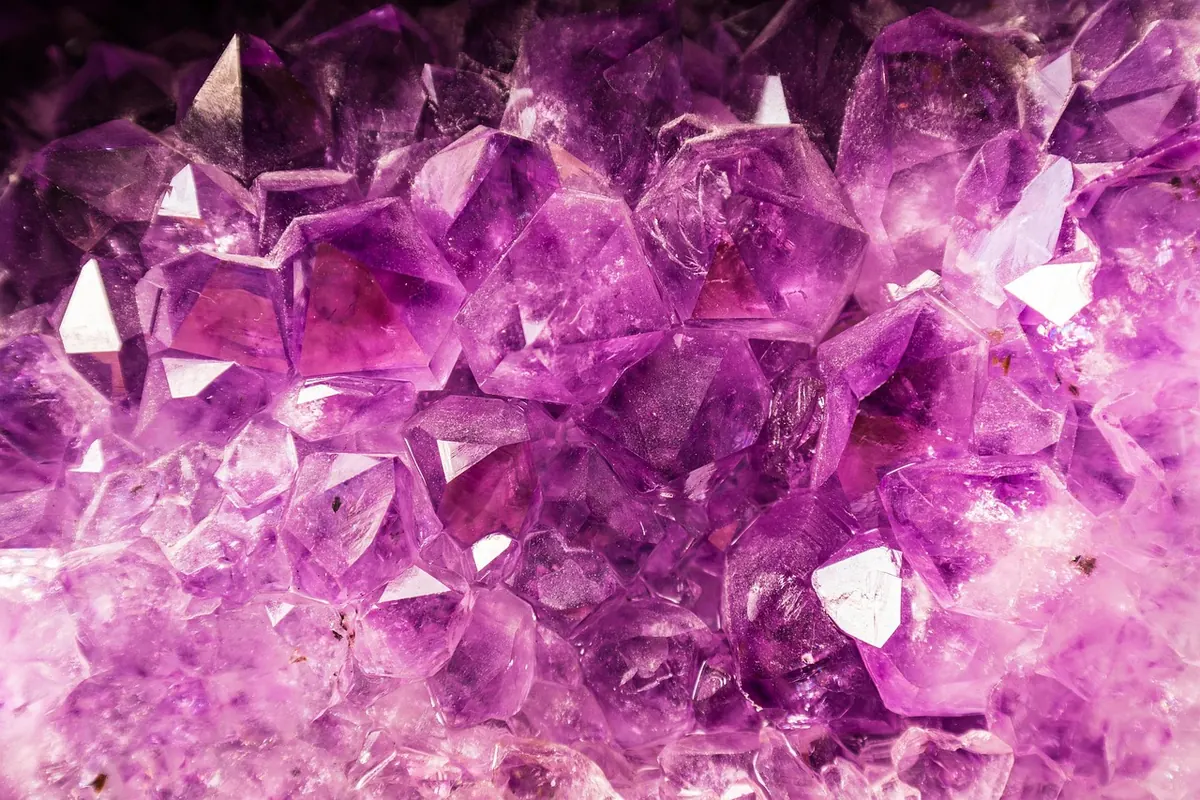
Amethyst is quartz with iron impurities that have been exposed to radiation, producing violet through a subtle structural change in the lattice. The colour is famously uneven: heating amethyst gently turns it yellow, which is why most citrine on the market is treated amethyst rather than the genuinely rare natural citrine. Natural citrine tends to be a pale, slightly smoky yellow with even colour. Heated material often shows a burnt orange tone and reddish tips where the original amethyst colour concentrated.
Rose quartz is usually massive rather than crystalline, coloured by trace elements combined with fine fibrous inclusions that scatter light — the same scattering that gives it a soft, slightly milky look. Transparent pink quartz crystals exist but are genuinely uncommon, and any seller offering them cheaply deserves polite scepticism.
Two more names you will meet: prasiolite, a green quartz usually produced by heating amethyst, and smoky amethyst, sold as ametrine when both colours appear in one crystal. Ametrine occurs naturally at a small number of localities, and much of what is sold as ametrine is treated or assembled, so ask.
Quartz With Guests: Rutile, Tourmaline, and Phantoms
Some of the most collectible quartz is defined not by its own colour but by what it caught.
Rutilated quartz holds fine golden needles of rutile, sometimes in dense sprays, sometimes as a few straight threads crossing the stone. Tourmalinated quartz carries black schorl needles instead, often at sharp angles to each other. Both formed when the quartz grew around minerals that had already crystallised in the same pocket.
Phantom quartz shows a ghostly earlier outline inside the crystal, marked by a dusty layer where growth paused and then resumed. A single phantom tells you the crystal survived a change in conditions; several stacked phantoms read almost like tree rings.
Quartz does not hide its history. It records it, layer by layer, and then lets you look straight through the record.
You will also see dendritic quartz with fern-like manganese or iron oxide patterns, often on fracture surfaces, and hematoid quartz with red iron staining. These are surface or near-surface features, which is fine — they simply occupy a different category from inclusions locked inside the lattice.
Reading a Specimen: A Short Checklist
When you pick up a piece, run through the same few questions each time. It takes about a minute and saves a lot of money.
- Is the colour even, or does it follow cracks and grain boundaries? Dye collects in fractures. Natural colour sits inside the material, not in the breaks.
- Can you see through the clearer parts? Good quartz should show you the far side of the crystal, even if faintly. A completely dead surface often means etching or heavy polishing.
- Are the terminations sharp and slightly asymmetric? Real points rarely have perfectly matching faces on all six sides. Uniformity suggests something poured or cut.
- Does it feel cold and heavy for its size? Glass warms quickly in the hand and feels lighter than it looks.
- Are there tiny bubbles in visible strings or clouds? Round bubbles in lines point to glass. Angular or irregular two-phase inclusions point to natural growth.
Natural, Treated, or Glass?
Treated quartz is not automatically bad. Heat treatment is standard, stable, and disclosed by any dealer worth returning to. Irradiation to deepen smoky colour happens as well, and it mimics a natural process closely enough that laboratory testing is the only reliable way to tell. What you should object to is silence. Ask directly: has this been heated, irradiated, or dyed? A confident seller answers without flinching.
Fakes are usually obvious once you know the tells. Cut glass beads and reconstituted blocks often show a faint swirl pattern, perfectly round bubbles, or a sharp colour boundary where two batches were joined. Quartz has a hardness of 7, so it scratches ordinary glass — a discreet test on a bead's hidden side tells you a great deal.
Building a Small Collection That Teaches You Something
Resist the urge to buy one of everything. Instead, collect in pairs. Buy a clear point next to a milky one from a similar region, a smoky crystal beside an amethyst, a rutilated piece beside a plain one. Comparison is where the learning actually happens; a single beautiful specimen on a shelf stays a mystery, while two specimens ask you to explain the difference.
Add a simple loupe, a small LED torch, and a notebook. Write down where each piece came from, what you paid, and what you noticed on the day you bought it. In a year the notebook will be more useful than any guide, because it will describe the stones in your own words.
And keep the cheap, cloudy, chipped pieces. They are the ones you can hold under a lamp, scratch with a nail file, and study without worrying about the surface. The expensive crystal in the cabinet teaches you what quartz can be; the flawed one on the desk teaches you what it is.
Photo: Didgeman / Pixabay